

 RU
RU 
The British school system rewards families who plan early, but first you have to read the map. This guide walks through every stage, from Reception to Sixth Form, the four standard entry points for international pupils, and the honest 2026/27 cost picture after the January 2025 VAT change. Use it to locate your child and set a clear timeline.
International families researching British schools run into the same wall of unfamiliar vocabulary: Key Stages, Reception, 11+, Sixth Form, UKiset, AEGIS. Layered on top is a reshaped cost picture: the 20% VAT on independent school fees that took effect on 1 January 2025 has pushed average fees to their highest year-on-year jump in two decades. This UK education system guide maps the system end to end, so parents can locate their child, plan the next entry point, and budget honestly for 2026/27. Consider it the UK education system explained for families who need to act, not just understand.
The UK has four nations and four slightly different school systems. England, which sets the framework most international families encounter, organises its national curriculum into blocks of years called Key Stages. These British education system stages run from Reception through to Sixth Form. Scotland, Wales and Northern Ireland diverge in qualifications and structure (a Scottish Higher is not an A-Level), but the broad age architecture is similar enough that families planning a move can use the English model as their baseline.
Compulsory schooling in England runs from age 5 to age 16. After 16, young people must remain in education or training of some form until 18: that can mean A-Levels, the International Baccalaureate, a college course or an apprenticeship. It does not automatically mean staying in the same school.
Two inspection regimes matter. Ofsted inspects state schools; the Independent Schools Inspectorate (ISI) inspects fee-paying schools belonging to the Independent Schools Council. The Key Stage framework, set out on gov.uk, is the backbone for everything that follows: ages, year groups, assessments and entry points all hang off it. Get the Key Stages UK schools are built around straight, and the rest of the British education system becomes legible.
The single most useful thing a parent can do early on is locate their child precisely in the year-group ladder. UK year groups are based on age at the start of the academic year (1 September), not on date of joining. The mapping below covers every stage from nursery to university entry:
The Early Years Foundation Stage covers nursery and Reception, ages 3 to 5. Key Stage 1 takes pupils through Years 1 and 2, ages 5 to 7. Key Stage 2 spans Years 3 to 6, ages 7 to 11, and ends with national SATs assessments in Year 6. In the independent sector this whole block (often plus Years 7 and 8) sits inside a prep (preparatory) school.
Key Stage 3 covers Years 7 to 9, ages 11 to 14, the broad foundation before GCSE specialisation. Key Stage 4, Years 10 and 11, ages 14 to 16, is the GCSE phase. Post-16, Years 12 and 13 (ages 16 to 18) form the Sixth Form, sometimes labelled Key Stage 5, where pupils study A-Levels or the IB Diploma. For a more detailed breakdown of the year ladder, see our companion piece on how many years students study in UK schools.
UK schools split first along the funding line. State schools are free, allocated largely by catchment area, and inspected by Ofsted. They educate roughly 93% of pupils. Independent schools (also called private schools, and confusingly called public schools when they are the most historic of them, such as Eton or Harrow) charge fees and are inspected by the ISI. Around half hold charitable status.
Within the state sector sit grammar schools, academically selective by 11+ examination and concentrated in particular counties. Within the independent sector, the structural distinction is age band: prep schools take pupils up to 11 or 13, senior schools from 11 or 13 onward, with Sixth Form at the top. Boarding schools are a subset of independent schools offering full, weekly or flexi boarding.
For international families, the practical reality is that the independent sector handles almost all overseas placements. It sponsors the Child Student visa, accommodates boarders, and runs admissions calendars built around international applicants. The UK school system for international students is, in effect, the independent system: even where a state grammar would be academically appropriate, immigration rules close that door for most overseas families.
Three formal assessment points shape a UK school career. SATs sit at the end of Key Stage 2, in Year 6 (age 11). They produce internal benchmarking data on English and maths but no certificate the child carries forward. Independent prep schools often opt out entirely.
GCSEs (General Certificates of Secondary Education) are the first qualification that matters externally. Pupils sit them at the end of Year 11, age 16, typically across 8 to 10 subjects. Maths, English language and at least one science are effectively compulsory; the remaining subjects mix humanities, languages, arts and further sciences. Grades run from 9 (highest) down to 1, with grade 4 the standard pass and grade 5 a strong pass.
A-Levels follow over two years in the Sixth Form. Most pupils take three subjects, occasionally four, chosen for depth and aligned with intended university courses. Schools generally require a minimum of five GCSEs at grade 4 or above, including English and maths, before admitting a pupil to A-Level study. The International Baccalaureate Diploma offers a broader alternative, examined at the same age. Both are widely accepted by universities in the UK, the US and across Europe. For the full mechanics of each examination, our guide to British exams from GCSEs to A-Levels goes deeper.
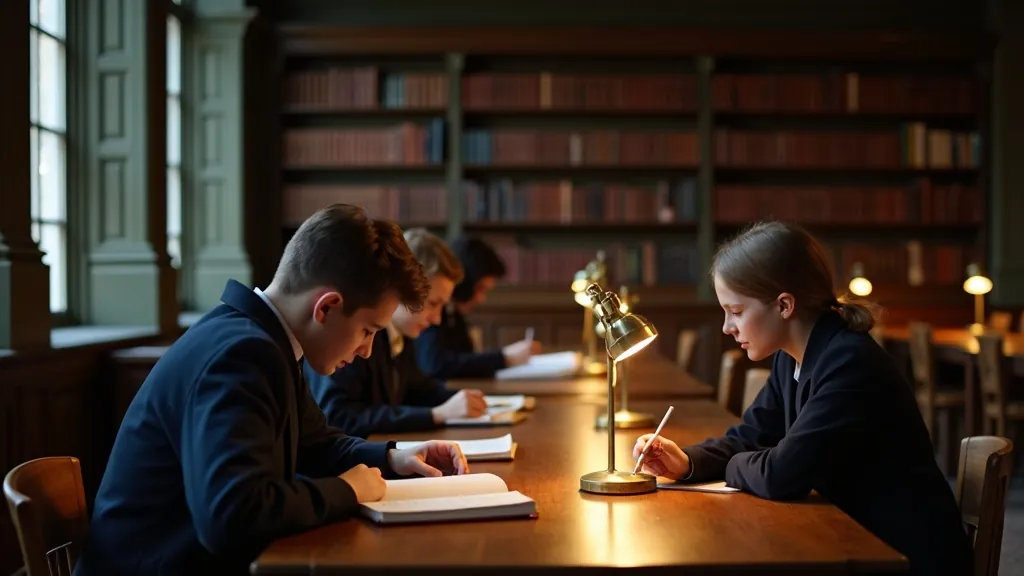
The Sixth Form is the decision point international families tend to feel most acutely, because these are the last two years before university and the qualifications taken here determine which institutions are realistic. A-Levels favour depth: three subjects, examined rigorously, well suited to pupils who already know they want to read medicine, engineering, law or economics. The IB Diploma favours breadth: six subjects across language, sciences, humanities and arts, plus an extended essay, theory of knowledge and a creativity-service component.
UK university applications go through UCAS, which accepts both qualifications without prejudice. Russell Group universities (the 24 research-intensive institutions including Oxford, Cambridge, Imperial and Edinburgh) publish offers in A-Level grades (typically A*AA to AAB at the most competitive) and equivalent IB scores (usually 36 to 40 points with specified higher-level grades). For families weighing the two routes against a child’s profile, our A-Level vs IB Diploma comparison sets out the trade-offs in detail. Both qualifications travel well: US, Canadian, Dutch and Singaporean universities accept them straightforwardly.
UK independent schools admit international pupils at four standard windows. The 7+ takes children into prep school at the start of Year 3. The 11+ is the main entry to senior school, taken in the year the child turns 11, and is the dominant route into many leading day schools and some boarding schools. The 13+ is the historic Common Entrance gateway into the most established boarding schools (Eton, Harrow, Winchester, Marlborough) and remains the most competitive single entry point for international families. The 16+ admits pupils directly into the Sixth Form for A-Levels or the IB.
Entrance exams are sat in the year before joining. September is the dominant intake; January and April places exist but are scarce and depend on a pupil leaving mid-year.
Three factors usually decide. Language readiness comes first: a child whose English is still developing benefits from joining earlier, gaining years of immersion before GCSEs begin. Boarding age comes second: many families and schools prefer 11 or 13 as a minimum, though some prep schools board from 7. Academic stage comes third: a child already deep into a national curriculum elsewhere may find 16+ entry into Sixth Form cleaner than mid-stream insertion into Year 10. Our piece on the best age to enrol in a British school works through these trade-offs by family profile.

Three procedural pillars turn a school offer into an enrolled pupil: an entry test, an accredited UK guardian, and a Child Student visa. Schools will not issue a sponsorship letter without the first two in place.
The UK Independent Schools’ Entry Test is an adaptive online assessment used by more than 100 leading independent schools to benchmark international applicants against their UK peers of the same age. It runs about three hours, covers reasoning and English proficiency, and costs in the region of £295 (verify the current fee on the UKiset site at the time of booking). A single sitting produces a profile that can be sent to multiple schools, which is why many families register for UKiset before they finalise their shortlist.
The Child Student visa applies to pupils aged 4 to 17 attending an independent fee-paying school in the UK. Sixteen- and 17-year-olds may use either the Child Student or the adult Student visa depending on the institution, and gov.uk should be the reference point for current rules. Every Child Student visa requires a UK-based guardian arrangement. AEGIS (the Association for the Education and Guardianship of International Students) accredits the guardianship organisations that boarding schools recognise as meeting safeguarding and welfare standards. An AEGIS-accredited guardian is, in practice, a prerequisite at most boarding schools.
The cost picture changed materially in 2025. From 1 January 2025, the Finance Act 2025 applied 20% VAT to independent school fees across the UK. From April 2025, charitable independent schools in England lost their 80% business rates relief. Together these policy shifts produced the largest annual fee increase in two decades.
The ISC Census 2025, the authoritative annual data from the Independent Schools Council, recorded an average termly day-school fee of £7,382 in January 2025 (roughly £22,150 per year), a 22.6% rise on the prior year. Boarding fees sit considerably higher, typically £45,000 to £65,000 a year at leading schools for 2026/27 entry. Pupil numbers in ISC schools fell by 13,363, a 2.4% drop, the first contraction of that scale on record.
For families budgeting for 2026/27: use the January 2025 ISC figures as your floor, expect each school’s own published fee schedule to sit above the sector average, and ask directly whether quoted fees are inclusive of VAT, extras and registration deposits. The ISC Census 2026 had not been published at the time of writing.
A realistic runway from decision to a September start is 12 to 18 months. Four workstreams run in parallel: shortlisting schools against the child’s academic profile and the family’s location preferences; registering for UKiset and any school-specific entrance exams in the right testing window; arranging AEGIS-accredited guardianship; and preparing the Child Student visa application once a sponsorship letter arrives.
Families who manage all four themselves can succeed, particularly at the 16+ entry point. The case for engaging a consultancy is strongest at 11+ and 13+, where assessment calendars are tight, school registration deadlines close two to three years before entry at the most competitive boarding schools, and a missed testing window can cost a year. EDVISION advisers work with international families across each stage of the UK education system, from initial shortlist to enrolment.
 At what age can my child start school in the UK as an international student?
Independent schools in England can admit international pupils from age 4, though in practice most boarding placements begin at 7, 11 or 13. The Child Student visa applies from age 4 at an independent fee-paying school. For families considering a very young start, language readiness and boarding-age suitability matter more than the minimum age the visa permits.
Is the UK education system the same in Scotland, Wales and Northern Ireland?No. This guide focuses on England, which is the framework most international families encounter. Scotland uses Highers and Advanced Highers rather than A-Levels; Wales and Northern Ireland have their own qualifications and inspection regimes. The broad age architecture is similar across all four nations, but if a school is in Scotland, confirm its specific qualifications before drawing comparisons with English schools.
How many GCSEs does my child need to progress to A-Levels?Most schools require a minimum of five GCSEs at grade 4 or above, including English language and maths, before accepting a pupil into the Sixth Form. Competitive schools and specific subject combinations often demand higher thresholds, for example grade 7 or above in a subject a pupil intends to take at A-Level. Check each school’s Sixth Form entry requirements directly, as they vary.
Do international students joining in Year 7 or later have to sit SATs?No. SATs are administered at the end of Year 6 (age 11) as internal school benchmarking and produce no qualification. A child joining in Year 7 or later will not sit SATs and will not be disadvantaged by having missed them. Many independent prep schools do not administer SATs at all, regardless of pupil nationality.
How much does a UK boarding school cost per year in 2026/27?Leading UK boarding schools typically charge between £45,000 and £65,000 per year for 2026/27 entry. The ISC Census 2025 recorded an average termly day-school fee of £7,382 (roughly £22,150 per year), a 22.6% rise driven by 20% VAT applied from January 2025 and the loss of business rates relief from April 2025. Always ask each school whether quoted fees are VAT-inclusive and what extras sit outside the headline figure.
Does my child need a UK guardian, and what does AEGIS accreditation mean?Yes, if your child is under 18 and boarding. UK schools require a UK-based guardian who can act in loco parentis for welfare, medical and emergency matters. AEGIS (the Association for the Education and Guardianship of International Students) is the accreditation body that sets safeguarding standards for guardianship organisations. Most boarding schools will only recognise guardians from AEGIS-accredited providers, making accreditation a practical prerequisite rather than an optional quality mark.
Can my child enter a UK independent school mid-year, or only in September?September is the dominant intake and the only entry point guaranteed at most schools. January and April places do exist but depend entirely on a vacancy arising from a pupil departing mid-year. For international families, relying on a mid-year place is a significant risk; planning for a September start with a 12-to-18-month runway is strongly advisable.
 GCSE subjects: the complete list and how to choose them
 Choosing GCSEs is a British school career’s first real academic decision: a compulsory core of English, maths and…
 The International Baccalaureate in the UK: a complete guide for international families
 The International Baccalaureate is the broad alternative to A-Levels: six subjects, a demanding core of independent…
 UK school immersion programme: try boarding before you commit
 Before a multi-year boarding commitment, let your child live it first. A school immersion programme places them inside…
 How to choose a British school: a parent’s decision guide
 Choosing a UK school is less about league tables than about fit. This guide turns the decision around: begin with your…
Submit your request and our manager will contact you shortly
 20 Wenlock Road, London, England, N1 7GU
 +44 7520 603085
 info@edvision-group.com


